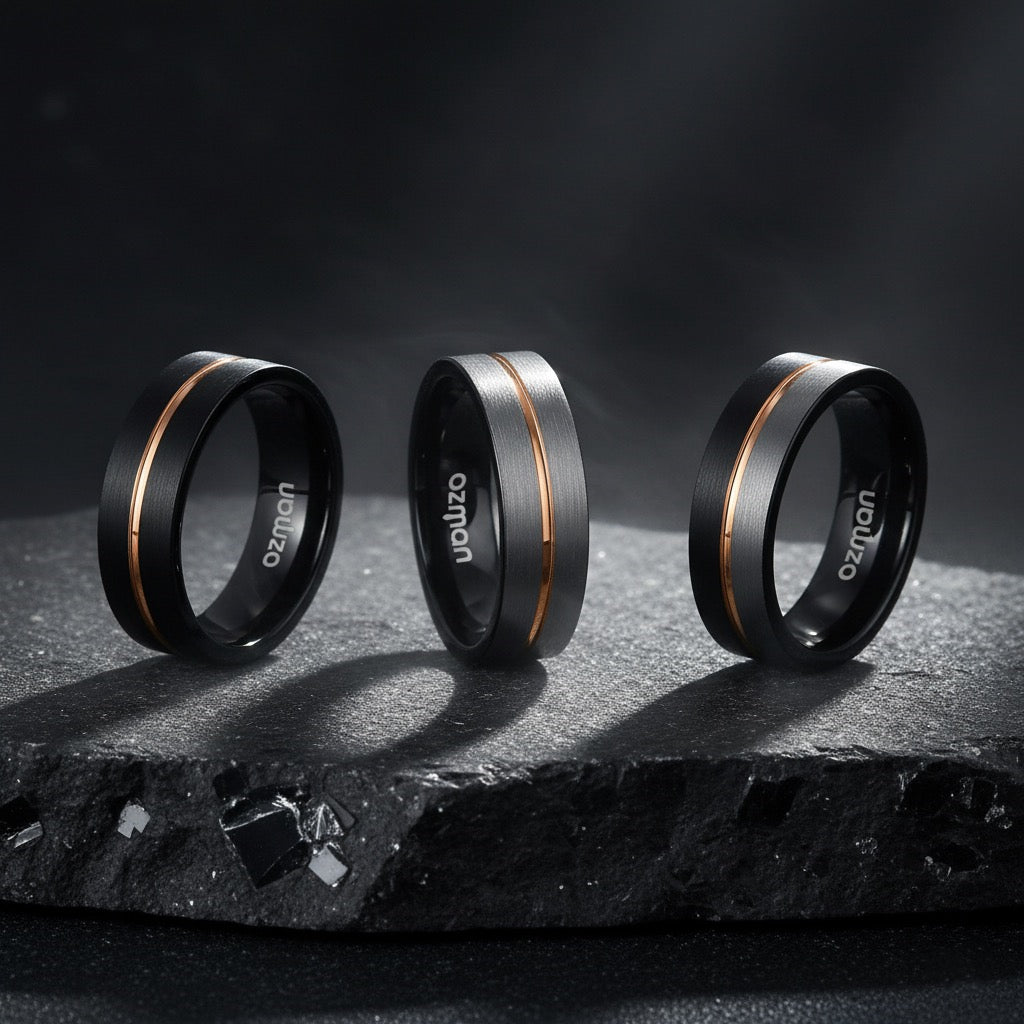

Measuring your ring size at home is fairly simple: measure the circumference of the finger where you'll wear the ring, repeat the measurement for accuracy, then compare it with the retailer's sizing information. Getting this right is particularly important when shopping for tungsten rings in Australia, as tungsten rings generally cannot be resized in the same way as traditional precious-metal rings.
What should you know before measuring your ring size?
Key takeaways
-
Measure the exact finger where you plan to wear the ring.
-
Measure more than once before deciding on your size.
-
Avoid measuring when your hands are unusually hot or cold.
-
Consider ring width as well as finger circumference.
-
Don't assume an existing ring is the correct size unless it fits the intended finger properly.
-
Take extra care with tungsten because resizing is generally not an option.
Ring sizing isn't something most people think about until they need to buy a ring online. Then suddenly you're looking at measurements and wondering whether a difference of a millimetre actually matters.
It can.
A wedding band or everyday ring needs to be secure enough that it won't slip off, but comfortable enough to pass over your knuckle without a struggle. This men's ring size guide will help you take a more reliable measurement at home before you place an order.
How should a men's ring fit?
A properly fitted ring should sit comfortably at the base of your finger without feeling as though it's squeezing the skin. When you remove it, there should usually be a little resistance as it passes over your knuckle.
You don't want it sliding around freely, but you shouldn't have to wrestle with it either.
This distinction matters because fingers aren't perfectly uniform. Your knuckle might be wider than the base of your finger, for example. In that situation, you need a size that can pass over the knuckle while remaining reasonably secure once the ring is in place.
When looking through men's tungsten rings, also pay attention to the width and profile of the band. Two rings in the same nominal size can feel slightly different because of their design.
How can you measure your ring size at home?
One simple approach is to measure the circumference of your finger using a narrow strip of paper or a non-stretch material that can wrap comfortably around it.
Wrap the strip around the base of the finger without pulling it excessively tight. Mark the point where the material overlaps, then lay it flat and measure the distance with a ruler that shows millimetres.
Repeat the process rather than relying on your first attempt.
Home measurement inevitably leaves some room for small errors, so consistency is useful. If you get noticeably different measurements each time, start again rather than taking an average and hoping for the best.
For greater confidence, a dedicated ring-sizing tool or professional measurement from a jeweller is preferable when available.
Can you measure an existing ring instead?
Yes, an existing ring can help determine your size, but only if it already fits the correct finger well.
Measure the inside diameter of the ring straight across its widest point, from one inner edge to the opposite inner edge. Don't include the thickness of the ring itself.
Accuracy matters here. A small difference in diameter can affect the resulting ring size, so use a ruler with millimetre markings or, preferably, a more precise measuring tool if you have one available.
There's an obvious trap too. A ring that fits your right ring finger isn't automatically the correct reference for your left ring finger. Even corresponding fingers on opposite hands can have different measurements.
Use a ring from the same finger whenever possible.
When is the right time of day to measure your finger?
Finger size isn't completely fixed throughout the day. Temperature, activity and other factors can temporarily change how your hands and fingers feel.
That means measuring once, particularly when your hands are unusually cold or warm, isn't ideal.
For a more useful measurement:
-
Measure when your hands are at a comfortable, normal temperature.
-
Avoid measuring immediately after strenuous exercise.
-
Don't measure straight after coming inside from very cold weather.
-
Take measurements at different times of the day.
-
Compare your results and look for consistency.
-
If you're between sizes, consider the band's width and the retailer's sizing guidance before choosing.
It might feel excessive to measure your finger three times just to buy a ring. But it's a lot less inconvenient than receiving a ring that doesn't fit.
Does the width of a men's ring affect its fit?
Yes. Band width can influence how a ring feels on your finger.
A wider wedding band covers more of the finger and may feel more snug than a narrow ring of the same nominal size. This becomes particularly relevant with men's wedding rings, where broader bands are common.
For example, a substantial flat or bevelled tungsten ring can feel different from a slimmer, more rounded design even when both are labelled with the same ring size.
This is why sizing shouldn't be considered entirely separately from style.
If you're used to wearing a narrow ring and you're moving to a much wider wedding band, don't automatically assume the same fit will feel identical. Consider the overall profile and width before ordering.
Are both hands the same ring size?
Not necessarily.
It's easy to assume that if you know the size of one ring finger, you've solved the problem for both hands. Human hands aren't that cooperative. Your dominant hand may be slightly different, and individual fingers can vary in circumference.
Always measure the finger where the new ring will actually be worn.
This is particularly important when buying a wedding band. If you're purchasing one of the many styles of men's wedding bands in Australia, measure the intended wedding-ring finger rather than borrowing a measurement from another finger because it's more convenient.
It's a small detail, but an important one.
What are the most common ring-sizing mistakes?
One of the biggest mistakes is wrapping paper or string too tightly around the finger. If the measuring material compresses the skin, the resulting size may be too small.
The opposite can happen as well. Leave too much slack and your measurement becomes larger than your actual finger.
Another common problem is ignoring the knuckle. If your knuckle is considerably wider than the base of your finger, a ring sized solely to the base may be difficult to put on and remove.
You should also avoid:
-
Guessing based on your height, weight or hand size.
-
Assuming men's ring sizes are standard across every sizing system.
-
Measuring a different finger and treating it as equivalent.
-
Using stretchy string that changes length while measuring.
-
Rounding measurements too aggressively.
-
Ordering before checking the retailer's sizing information.
The goal isn't to get a number as quickly as possible. It's to get a measurement you can actually trust.
Why is accurate sizing especially important for tungsten rings?
Tungsten is an extremely hard material, which is one of the characteristics that makes it attractive for men's rings. That hardness also changes what happens if you order the wrong size.
Traditional precious-metal bands can often be adjusted by a jeweller, depending on their construction and the amount of resizing required. Tungsten rings generally cannot be resized using those conventional techniques.
If your tungsten band doesn't fit, replacement may therefore be necessary.
This is particularly worth remembering when choosing a wedding ring that you intend to wear regularly. Whether you're considering silver-toned tungsten, a gold finish or black tungsten rings, spend a few extra minutes confirming your measurement before ordering.
It isn't the exciting part of choosing a ring. Still, it might be the most useful part.
Should a wedding ring feel tighter than a normal ring?
Not deliberately. A wedding band should be secure and comfortable rather than intentionally tight simply because you plan to wear it every day.
The right fit should allow the ring to move over your knuckle with some resistance and then sit securely at the base of your finger.
You may notice small changes in tightness during the day. That's normal because fingers can fluctuate slightly. What you don't want is a ring that regularly feels painfully restrictive or one that slides towards the end of your finger whenever your hand points downwards.
Comfort matters even more with an everyday wedding band because you'll notice a poor fit repeatedly. A ring can look fantastic, but if you're constantly twisting it, taking it off or worrying that it'll slip away, the size probably isn't doing you any favours.
What should you do if you're between two ring sizes?
If your measurements consistently place you between sizes, don't simply choose one at random.
First, repeat your measurements and make sure you're getting similar results. Then consider the ring itself. A broader band may feel more snug, while a slimmer profile may feel less restrictive.
Your knuckle shape matters too. Someone with a prominent knuckle needs to balance getting the ring comfortably over that point with preventing it from becoming too loose at the base of the finger.
This is one situation where getting professional sizing can be worthwhile, especially for an important purchase such as a wedding band.
And if you're ordering online, check the retailer's sizing information or ask for guidance before committing to a size. A quick question now can save quite a bit of inconvenience later.
Should you remeasure your finger before ordering?
Yes, especially if your last measurement was taken some time ago.
Finger size can change over the years, and an old ring size written down somewhere isn't necessarily your current size. Even if you've purchased rings before, confirming the measurement takes only a few minutes.
Measure the correct finger again, ideally at more than one time of day. Check that the results are consistent and consider the width of the ring you're planning to buy.
Then you can move on to the more enjoyable decisions, like whether you want something polished and classic or darker and more contemporary.
How can you order your next ring with more confidence?
Getting the size right before ordering online doesn't need to become a complicated exercise. Measure the intended finger carefully, check it more than once and pay attention to how the width and profile of your chosen ring may affect its fit.
For tungsten rings in particular, it's worth being precise because conventional resizing generally isn't available. A few careful measurements now can make the entire buying process much simpler.
Once you're comfortable with your size, you can focus on choosing a ring that actually suits you, whether that's a classic silver-toned band, a black tungsten design or something with a little more detail.
Ready to find the right ring for your size?
A good ring should look right, but just as importantly, it should feel right every time you put it on. Use this men's ring size guide before ordering, compare your measurements carefully and don't rush if your results aren't consistent.
When you're ready, explore the Ozman Trends ring range and find a style that works for your hand and personal taste. If you're unsure about sizing before you order, contact Ozman Trends for further assistance.